
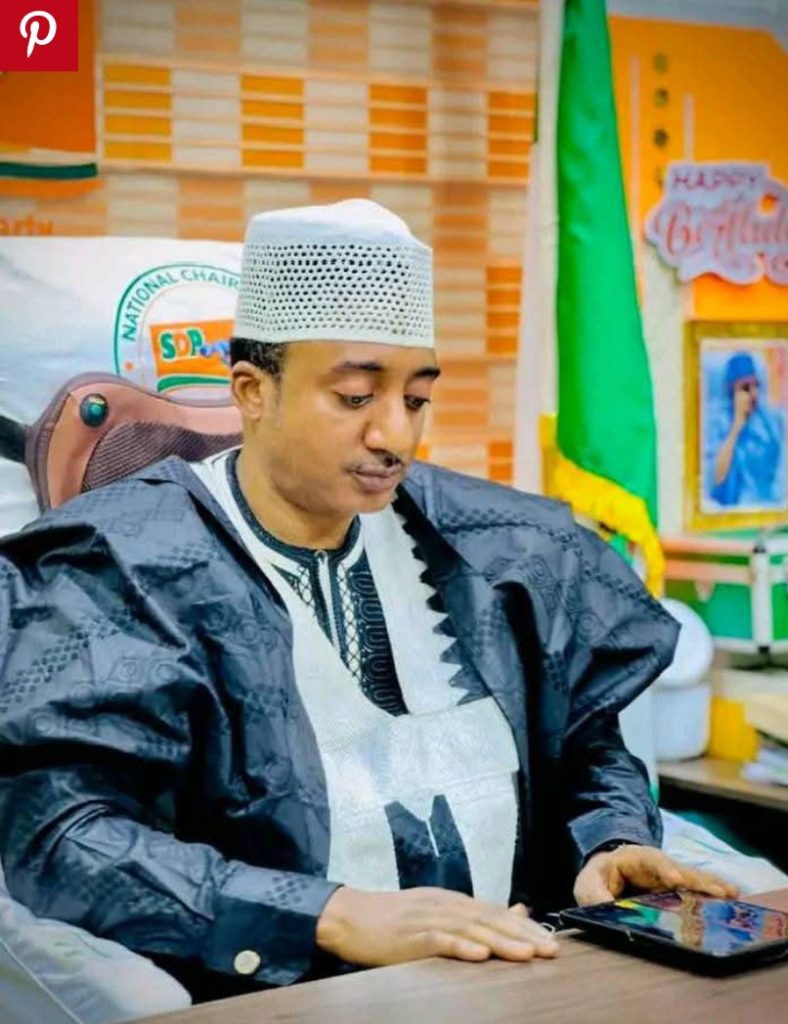
The National Chairman of the Social Democratic Party (SDP), Alhaji Shehu Musa Gabam, has raised concerns over what he described as political interference in Nigeria’s military operations, warning that countermanding battlefield decisions without clear constitutional authority poses grave dangers to national security.
Speaking during a televised interview on Nigeria’s worsening security situation, Gabam argued that the President, as Commander-in-Chief of the Armed Forces, bears ultimate responsibility for both kinetic and non-kinetic security strategies, stressing that no individual or institution has the constitutional power to override presidential directives to the military.
According to him, reports of troops being ordered to stand down at critical moments—sometimes when they were on the verge of reclaiming territory or making strategic arrests—are deeply troubling and require explanation at the highest level.
“We have seen communications, though unofficial, suggesting that the military had made serious inroads and were about to record major successes, only for them to receive instructions to withdraw,” Gabam said.
“The question is: who has the authority to give such an order apart from the President? If anyone else can countermand a presidential directive, then we are in a very dangerous situation.”
He referenced unresolved controversies surrounding the withdrawal of troops in parts of Kebbi State during incidents involving mass kidnappings, noting that despite debates at the National Assembly and complaints by state authorities, there has been no official clarification on who ordered the military to leave those locations.
Gabam insisted that Nigeria has the capacity to defeat non-state armed groups if decisive leadership is exercised, citing past administrations where firm presidential directives led to swift security responses.
“When a president gives a direct order on security, it is final,” he said. “No minister, no appointee, not even the Chief of Defence Staff can counter that order without reverting to the President. That chain of command must be respected.”
On foreign military involvement, Gabam criticised unilateral U.S. airstrikes in the region, arguing that such actions should give way to deeper cooperation that strengthens Nigeria’s own capabilities.
“I strongly believe these strikes by the United States should stop,” he said. “What Nigeria needs is cooperation—access to equipment, technology, and intelligence—not unilateral actions. Nigeria should be allowed to buy what it needs.”
He lamented what he described as longstanding restrictions on arms sales to Nigeria due to U.S. approval requirements for weapons with American components, calling for a review of Nigeria’s foreign policy to prioritise national security.
“Our military personnel are highly competent. Nigerian pilots operate precision-capable aircraft; our forces are trained and professional. The challenge is not competence, but access to the right equipment at a critical time,” he added.
Gabam urged the Federal Government to revive security negotiations with Washington, recalling that under former President Muhammadu Buhari, Nigeria successfully negotiated the purchase of Super Tucano aircraft following discussions with then U.S. President Donald Trump.
“There is no reason why that level of understanding cannot be restored,” he said, adding that Nigeria should also explore partnerships with other technologically advanced countries.
Turning to regional security, Gabam expressed concern over instability in the Sahel following the exit of Burkina Faso, Mali and Niger from ECOWAS, warning that porous borders have allowed armed fighters and weapons to flow into Nigeria.
He argued that Nigeria failed to adequately manage its relationship with Niger Republic, a country with which it shares extensive borders and deep historical ties.
“Niger is one of our closest neighbours, with vast and difficult-to-police borders. Our national interest and security concerns should have taken precedence,” he said.
Gabam advocated a return to strong bilateral engagement with Niger outside ECOWAS protocols, especially on intelligence sharing and border security.
He also referenced public statements by Niger’s military leader alleging that arrested criminals had named Nigerian officials as collaborators, claims he said should be treated with utmost seriousness.
“These are not issues to be handled with kid gloves,” he warned. “If protocols prevent us from addressing existential t
hreats, then those protocols must be broken.”
While commending Nigeria’s swift diplomatic intervention during the political crisis in Benin Republic for helping to preserve democracy, Gabam said it should also serve as a lesson on the dangers of poor intelligence coordination.
“No leadership has a monopoly on information,” he said. “Access to undiluted intelligence is critical, and any system that fails to prioritise this will face unprecedented challenges.”
He praised the Department of State Services (DSS) for its intelligence-gathering efforts, particularly under its current leadership, describing the agency’s head as “an operational professional” with strong field experience.
“Our security agencies, especially the DSS, are doing extremely well in intelligence gathering. But intelligence must be pooled, shared, and operationalised across agencies,” Gabam said.
He warned that Nigeria’s security risks are compounded by political tensions, approaching elections, logistical challenges, poverty, and widespread social frustration.
“You have hungry, angry populations, weaponised poverty, and political crises converging at the same time,” he said. “There must be deliberate efforts to reduce national tension.”
Gabam concluded by urging the President to assert his constitutional authority firmly, warning that any official who disregards presidential security directives is effectively undermining the Nigerian state.
“It is the President’s right and responsibility to ensure compliance,” he said. “Any act of defiance against the Commander-in-Chief is an act against Nigeria itself.”
END