
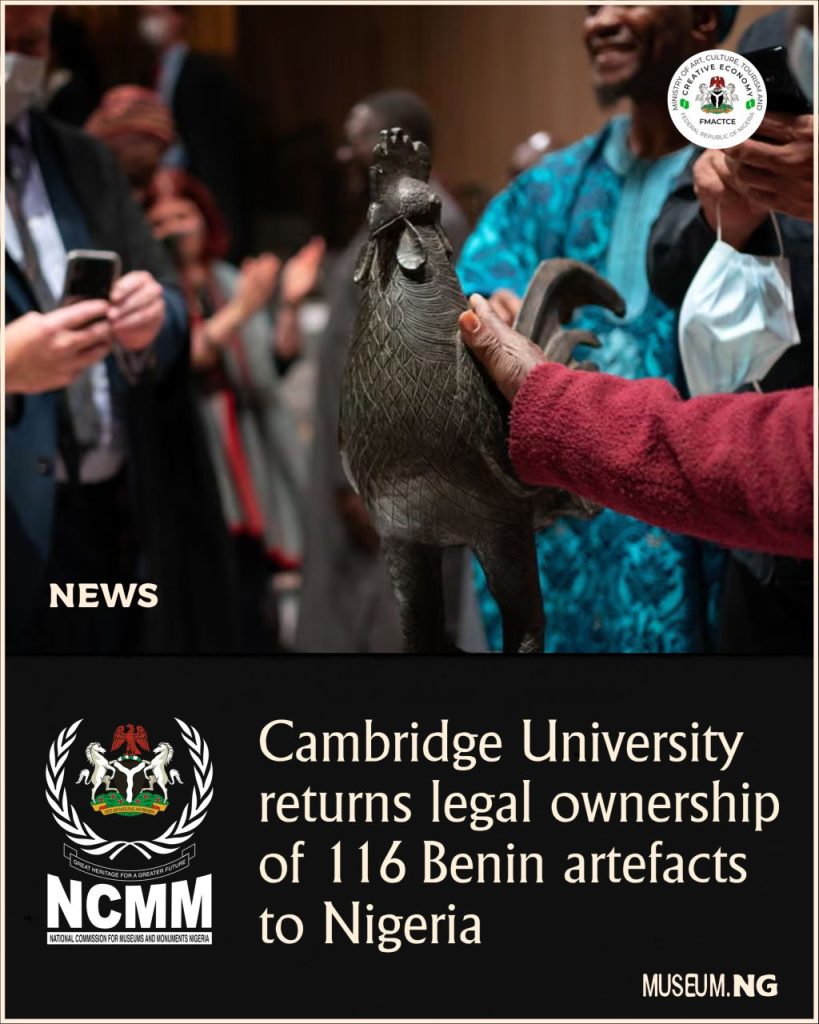
The University of Cambridge today announces it has transferred legal ownership of 116 Benin artefacts in the Museum of Archaeology and Anthropology (MAA) collections to Nigeria’s National Commission for Museums and Monuments (NCMM),operating under a management agreement with the Benin Royal Palace.
The decision follows the formal request from the NCMM, made in January 2022, for the return of artefacts taken by British armed forces during the sacking of Benin City in 1897. The University’s Council supported the claim and authorisation from the UK Charity Commission was subsequently granted.
Physical transfer of the majority of the artefacts will be arranged in due course. A small number of artefacts will remain on loan and on display at the Museum of Archaeology and Anthropology, to be accessible to museum visitors, students and researchers.
The University’s decision is in line with similar commitments made by other UK, US and European museums.
The 116 objects, primarily made of brass but also including ivory and wooden sculptures, were taken when British soldiers sacked Benin City in February 1897, during the so-called ‘Punitive Expedition’ mounted in response to a violent trade dispute the previous month.
As one of several UK museums with significant holdings of material taken from Benin in 1897, the MAA has been involved in long-term research and engagement projects in partnership with Nigerian stakeholders and representatives from the Royal Court of the Benin kingdom, as well as artists, academics and students from Nigeria.
MAA curators have participated in study and liaison visits to Benin City since 2018, meeting the Oba, members of the Court, state and federal government leaders, and cultural representatives. The University also hosted the Benin Dialogue Group in 2017, and welcomed NCMM and Royal Court representatives to Cambridge in 2021.
Olugbile Holloway, Director-General of Nigeria’s National Commission for Museums and Monuments, said: “This development marks a pivotal point in our dialogue with the Museum of Archeology and Anthropology at University of Cambridge and it is our hope that this will spur other museums to head in a similar direction. The return of cultural items for us is not just the return of the physical object, but also the restoration of the pride and dignity that was lost when these objects were taken in the first place. We would like to thank the Honourable Minister of Art, Culture, Tourism and the Creative Economy, Hannatu Musawa for all her invaluable support in making this happen and also we applaud Cambridge for taking this step in the right direction. We look forward to welcoming the artefacts back home soon.”
Professor Nicholas Thomas, Director of the Museum of Archaeology and Anthropology, said:
“It has been immensely rewarding to engage in dialogue with colleagues from the National Commission of Museums and Monuments, members of the Royal Court, and Nigerian scholars, students and artists over the last ten years. Over the period, support has mounted, nationally and internationally, for the repatriation of artefacts that were appropriated in the context of colonial violence. This return has been keenly supported across the University community.”
For more information contact:
Jessica Keating | jek67@cam.ac.uk | 07533115249, University of Cambridge
Dapo Sijuade | dapo.sijuade@ncmm.gov.ng |
What to know about National Commission for Museums and Monuments
About the National Commission for Museums and Monuments, Nigeria
The National Commission for Museums and Monuments (NCMM) is an offshoot of a department in the then Federal Ministry of Works that was established in 1943. It was transferred to the Federal Ministry of information as the Department of Antiquities by ordinance 17 of the Colonial Government of 1953. The NCMM is currently under the Federal Ministry of Art, Culture,tourism and the creative economy.
Presently the National Commission for Museums and Monuments manages and oversees fifty-three Museums and outlets spread across the country, sixty-five National Monuments and two World Heritage Sites. The museums are basically ethnographic and archaeological in nature. Some are specialised such as the Museum of Traditional Nigerian Architecture (MOTNA) and Zoological Garden in Jos, while others are localized with collections from the immediate environments, for example Igbo-Ukwu, Ile-Ife, Nok and Benin
The Commission as it is currently constituted is made up of six departments namely Departments of Museum; Research, Planning and Publications; Educational Services and Training; Monuments, Heritage and Sites; Finance and Accounts and Administration and Supplies.www.museum.ng
About the the Museum of Archaeology and Anthropology:
MAA, founded in 1884, is a museum of humanity’s history over hundreds of thousands of years, of world cultures over recent centuries, and of Indigenous life and art in the present.
Curators and Museum-affiliated researchers continue to collect contemporary material, with the support of communities they work with around the world. Increasingly, such collections are ‘co-produced’: local people consider how they want to be represented in a university museum in Britain and create artefacts and art works for us, on commission. MAA has also, over the last twenty years, built an increasingly important collection of contemporary art, representing Indigenous practitioners who otherwise lack visibility in UK art institutions, as well as British and other artists whose works are relevant to the Museum’s work and collections.
MAA is also a local museum. For nearly 140 years it has been the place where archaeological finds from Cambridge and from our region are preserved, researched and displayed. Locally and globally, it is a revelation of people’s stories, through extraordinary things they have made, past and present.
https://maa.cam.ac.uk/
About the University of Cambridge
The University of Cambridge is one of the world’s leading universities, with a rich history of radical thinking dating back to 1209. Its mission is to contribute to society through the pursuit of education, learning and research at the highest international levels of excellence.
The University comprises 31 autonomous Colleges and over 100 departments, faculties and institutions. Its 24,000 students include around 8,000 international students. In 2024, 71% of its new undergraduate students were from state schools.
Cambridge research spans almost every discipline, from science, technology, engineering and medicine through to the arts, humanities and social sciences, with multi-disciplinary teams working to address major global challenges. In the Times Higher Education’s rankings based on the UK Research Excellence Framework, the University was rated as the highest scoring institution covering all the major disciplines.
A 2023 report found that the University contributes nearly £30 billion to the UK economy annually and supports more than 86,000 jobs across the UK, including 52,000 in the East of England. For every £1 the University spends, it creates £11.70 of economic impact, and for every £1 million of publicly-funded research income it receives, it generates £12.65 million in economic impact across the UK.
The University sits at the heart of the ‘Cambridge cluster’, in which more than 4,500 knowledge-intensive firms employ more than 75,000 people and generate £25 billion in turnover. 26 billion-dollar businesses have been founded in Cambridge.
www.cam.ac.uk
SIGNED
NCMM PRESS UNIT