
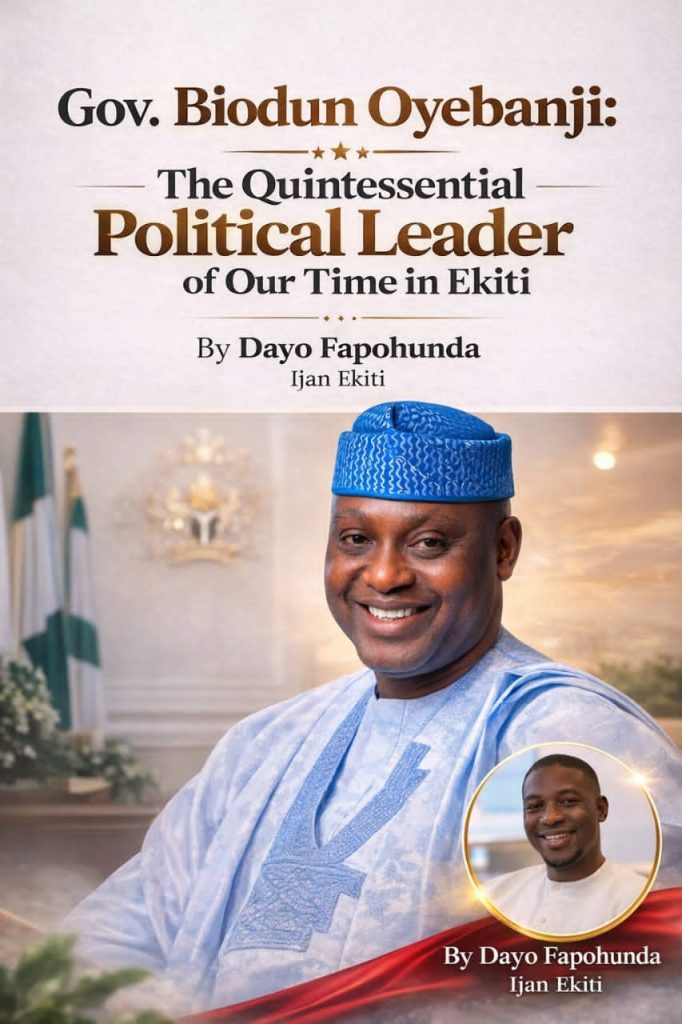
By Dayo Fapohunda,
Ijan Ekiti
Leadership is never an inborn virtue. It is not a mystical endowment mysteriously deposited in a few at birth, nor is it an ornament reserved for those whom destiny alone crowns with greatness. Leadership is neither accidental nor abruptly thrust upon an individual. It is acquired — patiently traded for through experience, assimilated through observation, and consistently brewed through a disciplined romance with vision, values, and responsibility. For one cannot offer what one does not possess.
History validates this eternal thesis. Kwame Nkrumah was not born standing on the balcony of independence; he grew into it through ideological study, activism, and global exposure. Chief Obafemi Awolowo methodically cultivated leadership through intellectual rigor, legal brilliance, organizational mastery, and philosophical clarity. Dr. Nnamdi Azikiwe’s cosmopolitan education and nationalist journalism refined his political consciousness, while Julius Nyerere’s moral discipline and philosophical depth elevated him into the revered teacher-leader of Africa. These men did not inherit leadership — they imbibed it, nurtured it, and disciplined themselves into it through association, education, and purposeful apprenticeship.
It is within this classical tradition of cultivated leadership that one must situate Governor Biodun Abayomi Oyebanji — a leader whose political evolution reflects preparation rather than accident, apprenticeship rather than abrupt ascension, and capacity rather than chance.
Long before destiny summoned him to the Government House, he had walked the corridors of governance, absorbing its rhythms and responsibilities. His early tutelage under former Governor Niyi Adebayo exposed him to the foundational architecture of democratic governance in Ekiti State’s formative years — a period that demanded institution-building, political balancing, and administrative stabilization. That exposure planted in him the ethics of public service and the discipline of governmental processes.
If that phase sowed the seed, his apprenticeship under Dr. Kayode Fayemi — particularly as Secretary to the State Government — watered and matured it. The Office of the SSG is governance in its most technical form: policy coordination, executive harmonization, institutional supervision, and administrative diplomacy. There, Oyebanji did not merely serve; he learned governance from the engine room. He interfaced with ministries, aligned development frameworks, managed executive decisions, and internalized the mechanics of statecraft. Thus, when he emerged as Governor, he did not arrive as a political learner. He arrived as a prepared mind — seasoned, tempered, and institutionally grounded.
Upon assumption of office, he immediately deployed this accumulated leadership capital with remarkable clarity of purpose. One of his earliest philosophical declarations defined his governance temperament: though a candidate of the APC, he would be Governor of all Ekiti people irrespective of political lineage. It was not rhetoric; it became policy posture. He moved swiftly to unify past predecessors, drawing them into the collective fold of what he christened “Project Ekiti.” In doing so, he neutralized succession rivalries, restored political continuity, and institutionalized the wisdom that development is cumulative, not competitive.
This reconciliatory governance model naturally dovetailed into his central mantra — Shared Prosperity. Not selective prosperity. Not partisan prosperity. Shared prosperity. In practical terms, this philosophy translated into deliberate welfare for retirees whose years of service built the state, the implementation of wage improvements for workers, and the assurance that governance dividends must touch every demographic layer. A government that honors its past strengthens its moral legitimacy in the present.
His administrative maturity further revealed itself in his doctrine of continuity. In a political environment where projects are often abandoned to discredit predecessors, Oyebanji chose the higher road — sustaining, completing, and commissioning inherited projects. Governance, under him, became a relay of progress rather than a theatre of ego. Roads left unattended were mobilized for repair and reconditioning, urban corridors revitalized, and rural access routes rehabilitated to stimulate commerce and mobility. Infrastructure, in his governance calculus, is not cosmetic — it is economic oxygen.
Understanding that development is also psychological — how a people see themselves and how others see them — his administration invested deliberate energy in Tourism, Arts, and Culture. Festivals, heritage assets, creative expressions, and cultural identity platforms have received renewed governmental attention, not merely as entertainment, but as economic drivers and identity consolidators. Ekiti’s cultural wealth is being repositioned as developmental capital, reinforcing the state’s soft power and tourism viability.
His developmental foresight is perhaps most boldly symbolized in the strategic opening up of Ekiti through air transportation. By strengthening aviation access and supporting the operationalization of the state’s cargo airport vision, he has effectively redrawn Ekiti’s economic map — positioning it for investment inflow, tourism traffic, agro-export logistics, and business mobility. Connectivity, in modern governance, is competitiveness — and Oyebanji understands this with striking clarity.
Security, the bedrock upon which all development rests, has also received firm attention. Through multi-agency collaboration, community engagement, and strategic security investments, Ekiti has retained and strengthened its reputation as one of Nigeria’s safest states. Investors require safety. Tourists demand security. Citizens deserve peace. His administration has treated these not as slogans but as governance imperatives.
Across sectors — infrastructure, public service welfare, tourism development, aviation access, cultural promotion, and security stabilization — his leadership temperament remains consistent: calm, inclusive, consultative, and result-driven. He governs without theatrical noise yet delivers with administrative firmness, echoing the wisdom that true leadership is measured not by decibel but by impact.
Although there persists a popular belief that some are born leaders, the Oyebanji example reinforces the more enduring truth , and leadership can be cultivated to excellence. His journey from apprenticeship to stewardship illustrates preparation meeting opportunity, learning maturing into capacity, and tutelage flowering into statesmanship.
By unifying political blocs, honoring predecessors, prioritizing workers and retirees, sustaining projects, repairing roads, opening air corridors, strengthening tourism and cultural assets, and securing the state, Governor Biodun Abayomi Oyebanji has added tangible value to Ekiti’s developmental trajectory and political culture.
In him, Ekiti witnesses leadership not improvised but prepared not inherited but earned not loud but effective.
And in that carefully cultivated stewardship stands, unmistakably, the quintessential political leader of our time in Ekiti.
..Dayo Fapohunda, an international Statistician from Ijan Ekiti.