
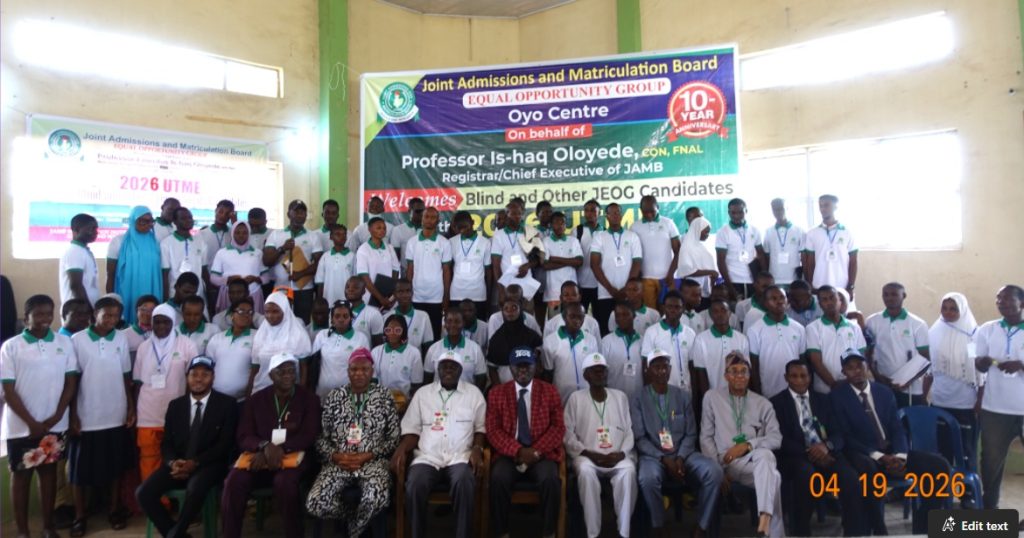
The 2026 Unified Tertiary Matriculation Examination (UTME) has recorded another milestone in inclusive education, as 536 blind candidates and others with special needs are participating in the exercise nationwide.
Chairman of the JAMB Equal Opportunity Group (JEOG), Emeritus Professor Peter Okebukola, commended the Registrar of the Joint Admissions and Matriculation Board (JAMB), Professor Is-haq Oloyede, for what he described as an unprecedented commitment to equal access to higher education in Africa.
Speaking to journalists on Monday, at the commencement of the special UTME sessions, Okebukola who is also the President of the Global University Network for Innovation (GUNi-Africa,
emphasized that the Oloyede-led administration has consistently ensured that no qualified Nigerian is denied the opportunity to sit for the examination on the basis of disability.
He noted that JAMB’s policy is anchored on fairness and inclusion, stressing that every candidate who meets the academic requirements deserves a realistic chance of gaining admission into tertiary institutions.
According to him, the 536 candidates are being examined across 11 designated centres nationwide, under arrangements tailored to their needs.
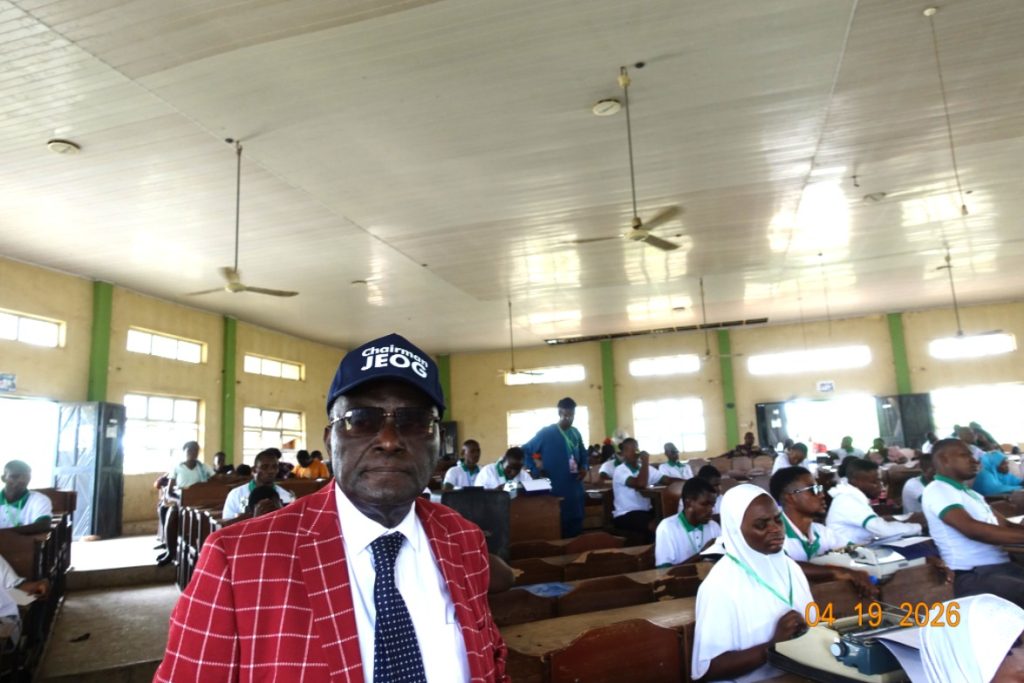
Since 2017, JAMB—through JEOG—has provided extensive support, including free accommodation for candidates and their guides, feeding, transportation support, and customized materials.
Okebukola also highlighted the continued use of a bimodal examination system, which allows candidates to choose between Fully-Braille and Fully Read-Aloud formats. This approach, now implemented for the third consecutive year, has significantly improved accessibility and candidate experience.
Providing a breakdown of candidate distribution, he revealed that Kano recorded the highest number with 136 candidates, followed by Lagos with 95, while Abuja hosts 46 candidates.
Other centres include Ado-Ekiti, Bauchi, Benin, Enugu, Kebbi, Oyo, Jos, and Yola, each supervised by experienced academics, many of whom are former vice-chancellors.
Beyond participation, Okebukola expressed satisfaction with the improving admission outcomes for candidates with disabilities. In the 2025 admission cycle, 483 candidates applied for tertiary education, out of which 252 secured admission—representing a 52.2 percent success rate.
Candidates with visual impairment formed the largest group, accounting for 429 applications, with over half successfully admitted. Other categories, including candidates with Down Syndrome, Autism Spectrum Disorder, and Dyslexia, also recorded notable admission rates, with Dyslexia candidates achieving a 100 percent success rate.
He further noted growing interest among candidates in science, technology, engineering, and mathematics (STEM) subjects, describing it as a positive shift.
However, he acknowledged ongoing challenges faced by blind students in pursuing science-related disciplines and disclosed that efforts have been underway since 2018 to address these barriers.
Since its establishment, JEOG has facilitated UTME participation for about 3,200 candidates with disabilities, with more than one-third gaining admission into Nigerian tertiary institutions.
The initiative, Okebukola said, has gained recognition across Africa as a model for inclusive education.
As he prepares to step down in August 2026 after a decade of service, Okebukola praised the sustained leadership of Oloyede, noting that the achievements of JEOG reflect a strong institutional commitment to equity and opportunity in Nigeria’s education system.
End