
By Onyeka Ezike
The recent surge in air ticket prices has continued to generate heated debate across various quarters, from the National Assembly to industry practitioners and air passengers. In December, air tickets soared from N150,000 to as high as N400,000, depending on the airline operator, for a one-way trip, a development that sparked concerns about the timing of the increase during the yuletide season.
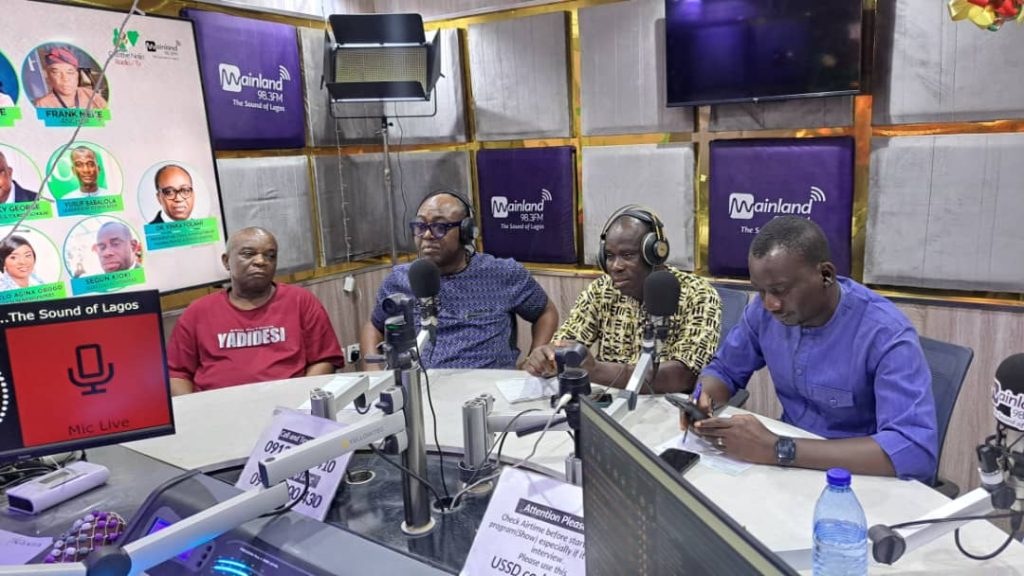
Speaking on a panel discussion on Creative Nigeria, a tourism and culture magazine programme anchored by award-winning veteran journalists Frank Meke and Bunmi Bade Adeniji on Mainland 98.3FM (aired every Thursday, 10-11 am), Dr. Yinka Folami, President of the National Association of Nigerian Travel Agencies (NANTA), addressed the controversy surrounding domestic airfares.
Dr. Folami clarified that much of the conversation about domestic air fares is speculative, noting that NANTA, with its training in ticketing operations and airfare construction, speaks authoritatively from gathered information.
“I don’t think it was Allen Onyema that made the statement that sparked the debate about taxes in the aviation sector. There are two issues here: the first is whether government taxes are responsible for the seasonal hikes, and the answer is no. Government taxes didn’t change in December,” he stated.
Dr. Folami explained the seasonal hike while citing government taxes. He said that in June, tickets to Abuja cost approximately N145,000 to N150,000 for a one-way trip, while the same ticket in December ranged from N255,000 to N300,000. He described the seasonal hikes as normal business practice in the aviation industry, driven by market factors and increased yuletide demand, rather than government taxes.
The NANTA President also addressed assertions making the rounds about 18 government taxes in the aviation sector, stating that NANTA, an association with 50 years of experience in the industry, has never encountered such claims.
Chinelo Agina Obogo, a Journalist from the Daily Sun Newspaper, disagreed with assertions that flights in Nigeria are the cheapest, stating that such claims cannot be supported with accurate and factual data. She advised the government to be more sensitive to airlines’ concerns.
“The government should listen to the airlines and their complaints, and let them itemize areas in the tax policy that can increase airfares. When you compare our air tickets with those of other countries relative to our minimum wage, Nigerians still pay the most expensive airfares. Let the government call the airlines and work out a resolution to help,” she urged.
Yusuf Babalola, a Journalist from the Leadership newspaper, explained government response and intervention in the aviation sector. He said that there are numerous underlying issues affecting the sector. He noted that Nigerians are at the receiving end, especially with the commencement of the new tax law.
“Nigerians don’t want anything that will burden them further. They may be saying taxes are draining them, but the government is also listening,” he said.
Babalola cited two instances where the government responded to airline concerns. The Presidential Committee on Tax Reform announced that airlines would be exempted from the 10% withholding tax and expressed its intention to engage aviation stakeholders to agree on an appropriate tax percentage. Additionally, the Nigeria Customs Service (NCS) withdrew the 4% Free on Board (FOB) levy on imported goods like aircraft and spare parts for commercial airline operators.
“We know the Christmas season is a peak period for airline operators, but they should stop the insensitive increase in airfares. The flying public finds this shocking and overwhelming; they should look inward on how this can be effectively managed in December,” Babalola stated.
On the Issue of Multiple charges and levies, Segun Kioki, a Journalist from the Guardian Newspaper, with extensive industry knowledge, examined the issue of multiple charges and levies in the aviation industry from multiple perspectives: airline operators, passengers, and government. He confirmed that airlines’ complaints about multiple taxes are valid, though he could not verify claims of 18 different taxes.
Kioki highlighted several known charges: Aviation Fuel Surge charge paid to the Federal Airports Authority of Nigeria (FAAN); Passenger Service Charge (PSC) of N5,000 minimum from FAAN-controlled airports (N10,000 at private airports like Asaba International Airport); landing fees; airport parking fees; and other levies.
He noted that FAAN also collects fees from passengers using international terminals $80 within West Africa and $100 for other international routes. Additional charges include Common User Terminal Equipment (CUTE) charge of $1.40 paid to FAAN by airlines, a security levy of $20, and Nigeria Immigration Service (NIS) data capturing levy of $11.50 per ticket. In total, passengers pay $35.10 in security levies per ticket.
“The airlines are discriminatory, but it is not just limited to the airlines alone; it’s a Nigerian factor,” Kioki observed.
a travel/hospitality expert and publisher of African Travel Times,
Dr. Lucky George, a Public Relations and Tourism scholar and publisher of African Travel Time, identified a lack of capacity as the fundamental problem in the Nigerian aviation sector.
“For a country with a market population of over 200 million people, if a return ticket costs N150,000 Lagos-Onitsha, you will have movement both ways. Over 80% of Nigerian travellers go by road; however, most people want to travel by air, even if just once in their lifetime, but the cost discourages them. Sometimes, the marketing tactics by the airlines and their operational methods affect the situation,” he said.
In his remarks, veteran journalist and the CEO of Cre8tive 9ja, Frank Meke, advised airlines to prioritize patriotism in their business operations. He also pointed to infrastructure deficits, noting that good road networks and inland waterways with ferries would create healthy competition and reduce pressure on air travel.
“Even the Nigerian Civil Aviation Authority (NCAA) has enabling acts that can checkmate all these increments, but why are they not doing so?” Meke queried.
In his closing remarks, Dr. Folami gave NANTA’s position, while maintaining that the issue transcends individual personalities. He focused on the speculation around 18 taxes while emphasizing NANTA’s professionalism in protecting the aviation industry and maintaining a customer-centric balance.
“What we know is because we are trained. If you scan an average domestic ticket, you would find about four taxes, including Quick Turn (QT), which goes to FAAN, an engineer levy for the government (NCAA), basic fare, and an emergency tax called YQYR,” he explained.
Dr. Folami stated that the issue of taxation in the aviation sector should not be approached habitually, adding that if this is achieved, it would be in everyone’s interest, airlines, the travelling public, and the government alike.